
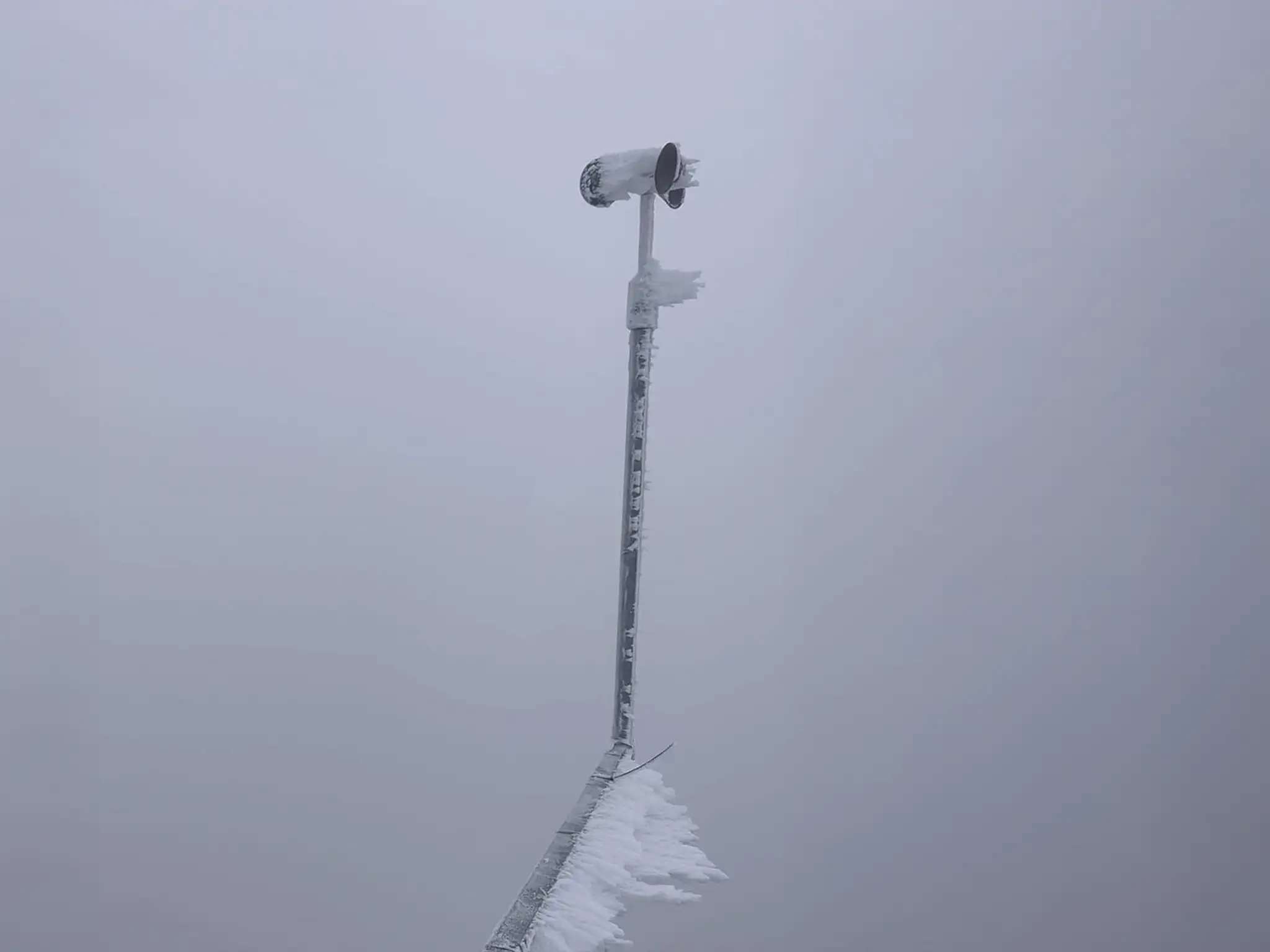
In wind measurement campaigns carried out in cold climates or high-altitude locations, ice is one of the main enemies of accuracy.
Many anemometers include heating systems, but in most models only the shaft or bearing is heated, allowing the sensor to continue spinning even when the cups are covered in ice.
At first glance, the anemometer appears operational, but in reality the cups lose their original geometry and the mass distribution is altered.
The behaviour of the sensor then diverges from its laboratory calibration, generating significant errors in the measurement of wind speed.
The result is data that appears valid but is physically incorrect, especially during periods of intermittent ice formation, when the recorded speed no longer represents the actual airflow.
In these conditions, partial heating does not guarantee data reliability.
Solutions to Minimize the Effects of Ice on Measurement
Ice not only interrupts campaigns: it can also distort data for hours or days without being easily detected.
Therefore, having a strategy against freezing is essential to maintain data quality and traceability.
- Full Sensor Heating
Some anemometers incorporate complete heating in both the shaft and the cups, preventing ice accumulation in critical areas.
However, this system is offered by only a limited number of manufacturers and its electrical consumption is high, which complicates its use in remote locations or autonomous systems.
- Use of Sensors Less Prone to Freezing
A practical alternative is to use anemometers such as the RM Young Alpine, which—although not as precise as First Class sensors—are more resistant to ice formation.
Comparing their readings with those of a main reference sensor allows anomalies or periods affected by freezing to be detected.
- Heated Ultrasonic Anemometers
Ultrasonic anemometers avoid moving parts, reducing freezing issues.
Still, they also require heating on their arms or probes, and consumption may be high depending on the degree of thermal protection.
The more heated components the sensor has, the more reliable the measurement—provided the power supply is correctly dimensioned.
- Temperature and Humidity Measurement
Recording temperature and relative humidity is essential for identifying conditions conducive to ice formation.
These parameters help validate data series and distinguish freezing-related errors from real wind variations.
- Visual Verification via Cameras
An ingenious solution is to install cameras aimed at the sensor, sending periodic images or videos.
The photographs allow visual verification of ice presence, correlation of incidents, and reinforcement of campaign quality control.
In summary, there is no single universal solution against ice, and reaching availabilities close to 100% is difficult.
However, there are measures we can take to improve data availability and verify its quality.